

Posted on April 28, 2003
Introduction
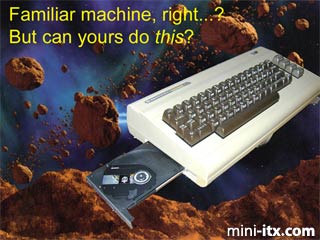
The Geek inside took over command the minute I spotted the M9000.
The nice compact layout, the onboard features, the impulse-buyer-friendly price and the power (enough for the usual stuff while I have to feed my P4 with SETI or Folding@home just to keep it from becoming bored), had not passed unnoticed. I didn"t care too much about the power consumption, you need an power outlet anyway if you want to do some serious work or want to see the end of the DVD for that matter. Didn"t care about reviews talking nonsense about gaming performance and other trivia. Didn"t care at all. The Geek inside talked in its authoritive voice: "Buy one, buy one! You must! Must!" The Geek inside usually wins, especially around payday. This time it won without a struggle. Payday was yesterday…
There it was, being admired, caressed, turned over and admired once more by yours truly.
The shiny heatsink, the little fan waiting in anticipation, the hidden processor not knowing when its first set of instruction would arrive, aaah the joy!
OK, now that I had it and had satisfied the basic need of just needing one (you fellow Mini-ITX-ers know what I am talking about), the inevitable question arose:
"What to do with it?"
It was about to become my fifth computer, and I could really not think of yet another "serious" purpose for this machine. This time I would not convince the girlfriend that it was a necessary piece of kit that was absolutely needed for some scientific groundbreaking work. This time I might even have to hide it from her eyes. Familiar feeling, friends? Ok, so it was about to become my first totally superfluous computer.
So what.
This was to be a project to fulfil some
basic needs. You just know that some people have those. Now
that I have introduced you to the rational reasons why I had
to get hold of one of these puppies (none, as you would have
guessed by now), I am about to tell you how this project turned
into: "The Commodore 64 @ 933.000 Mhz"
Seeing all the nice, funny and wonderfully ridiculous housings on mini-itx.com, I decided to revive "The Significant One from the "80s". Then, I used to have a Commodore 16 on which I experimented with BASIC programming until it decided to retire after a physical "Peek" and subsequent "Poke" in its internals. "That, you should not have done, my friend…", was the feeling I was left with when the screen turned black, never to return. The C16 was thrown away. That was unwise since they are quite a little bit rarer than the 64 and nice to look at. Remember they were dark grey with light grey keys? Anyway, Nostalgia took over (two very influential powers "Nostalgia & the Geek inside" you see…) and I bought a defect C64 on Ebay for almost two Euros. Sometimes you just have to throw in some serious money to get what you really, really want :-)
Here it is, looking very sharp, its original design appealing as always and complimentary with a nice touch of fading and aging of the plastic housing, adding to the feel of authenticity:
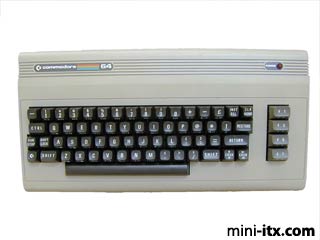
First its defective intestines were to be surgically removed, which was easy enough by just unscrewing the case (three screws from the bottom) removing the upper lid holding the keyboard (taking care not to break or severe the plastic hinges on the upper lid; they are a little weak), disconnecting the keyboard and power LED cable from the mainboard.
A couple of screws (eight if I am not mistaken) had to be removed before the complete mainboard could be taken out of its natural habitat.
What is left will look like this
depending on your skills not to break stuff:
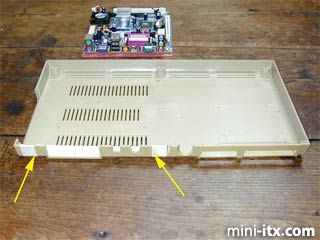
Here you see the empty undertray
of the C64, with some tape to mark and protect the area that
is to be milled out for a close fit of the EPIA. Oh, you can
see it in the background of the picture giving a good representation
of the relative dimensions of the donor / recipient. The piece
of plastic that has to be removed is exactly between two little
ridges (arrows) on the inside of the undertray; the EPIA I/O
backplate fits like a glove between them. Of course this is
purely coincidental but for people that want to do this casemod,
it is very convenient to know. Also notice that because the
C64 originally ran @ a mere 1.023 Mhz the heat produced by
the 6510 processor did not require a fan to cool things down.
Some slots provided the necessary airflow and I am very happy
to say that they are located at the area where the EPIA is
to be fitted. This is the second coincidence, hmm…
|
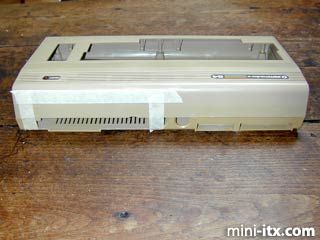
In the picture above you can see the plastic removed from the undertray, while the upper part is taped to get the same treatment in just a minute.
 |
 |
 |
Quick Links
Mailing Lists:
Mini-ITX Store
Projects:
Show Random
Accordion-ITX
Aircraft Carrier
Ambulator 1
AMD Case
Ammo Box
Ammo Tux
AmmoLAN
amPC
Animal SNES
Atari 800 ITX
Attache Server
Aunt Hagar's Mini-ITX
Bantam PC
BBC ITX B
Bender PC
Biscuit Tin PC
Blue Plate
BlueBox
BMW PC
Borg Appliance
Briefcase PC
Bubbacomp
C1541 Disk Drive
C64 @ 933MHz
CardboardCube
CAUV 2008
CBM ITX-64
Coelacanth-PC
Cool Cube
Deco Box
Devilcat
DOS Head Unit
Dreamcast PC
E.T.PC
Eden VAX
EdenStation IPX
Encyclomedia
Falcon-ITX
Florian
Frame
FS-RouterSwitch
G4 Cube PC
GasCan PC
Gingerbread
Gramaphone-ITX-HD
GTA-PC
Guitar PC
Guitar Workstation
Gumball PC
Hirschmann
HTPC
HTPC2
Humidor 64
Humidor CL
Humidor II
Humidor M
Humidor PC
Humidor V
I.C.E. Unit
i64XBOX
i-EPIA
iGrill
ITX Helmet
ITX TV
ITX-Laptop
Jeannie
Jukebox ITX
KiSA 444
K'nex ITX
Leela PC
Lego 0933 PC
Legobox
Log Cabin PC
Lunchbox PC
Mac-ITX
Manga Doll
Mantle Radio
Mediabox
Mega-ITX
Micro TV
Mini Falcon
Mini Mesh Box
Mini-Cluster
Mobile-BlackBox
Moo Cow Moo
Mr OMNI
NAS4Free
NESPC
OpenELEC
Osh Kosh
Pet ITX
Pictureframe PC
Playstation 2 PC
Playstation PC
Project NFF
PSU PC
Quiet Cubid
R2D2PC
Racing The Light
RadioSphere
Restomod TV
Robotica 2003
Rundfunker
SaturnPC
S-CUBE
SEGA-ITX
SpaceCase
SpacePanel
Spartan Bluebird
Spider Case
Supra-Server
Teddybear
Telefunken 2003
TERA-ITX
The Clock
ToAsTOr
Tortoise Beetle
Tux Server
Underwood No.5
Waffle Iron PC
Windows XP Box
Wraith SE/30
XBMC-ION