

Posted on July 31, 2003
|

The CuAl, or the amPC, or the Silent Server.
My mission, should I
choose to accept it was to build a silent web server. The
reasons were simple: I didn't want to pay someone to host
a site I could host myself and
I wanted to be able to sleep without
noisy fans keeping me awake.
The server that I was using was already very
quiet, the small PSU had a quiet 60mm fan and I had replaced
the cpu fan with
a Papst fan that one retailer described as "it literally
produces no sound whatsoever". Well I am not Clark Kent,
and I do not have super-hearing, and I can still hear it,
even running at 7v... even now, if you listen carefully,
on a moonlit night, you can still hear it wailing in my room
:) So I decided that I had to have a machine without any
fans and thought I would plump for the ME6000. That was until
I read that the Nehemiah performance gains don't merely benefit
media players, and decided that that performance gain and
the challenge of building a passive heatsink were worth the
extra £20. As for the case of the machine, I was at
a bit of a loss. Then I had a look around our garage and
found an old Cambridge
Audio A4 amp that I had blown up a couple of years ago, with
some nice big heatsinks and corresponding vents already in
it :)
The plan was to get the CPU as close as possible to the heatsinks and then get the heat over to them somehow. I looked at heat pipes, which is what The Hush uses, but they looked a bit complicated to build, and it seemed that pre-built ones would be difficult to shape without breaking (I am still interested though, if anyone can help me with this I would love to hear from you). So the other obvious option was to cut a thick sheet of a good conductor (I hear copper is cheaper than silver :) and clamp it to the CPU and heatsinks. Looking at pictures of the motherboard showed that the CPU was, usefully, placed very close to one edge of the board. Obviously I would need to use plenty of heat transfer gunk and I'd also been advised that I would need to isolate the CPU from heatsink.
I thought I probably wouldn't use any of the buttons on the front panel, as I didn't want anyone accidentally switching off my server.
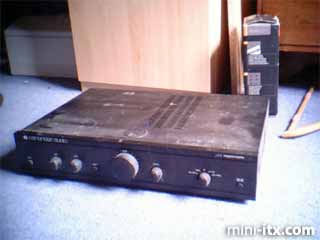
The Amp in its original, somewhat dusty, state...
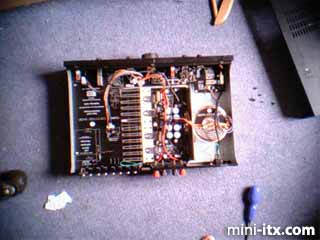
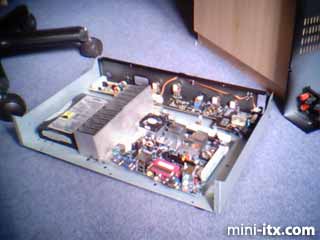
...and the innards, note the lovely big aluminum heatsinks, and the empty PCB on the left, for the optional phono stage, which I thought was probably just about a perfect size for a hard disk to sit on.
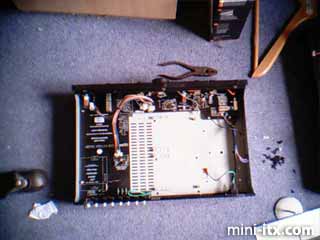
The case minus the main board and heatsinks.
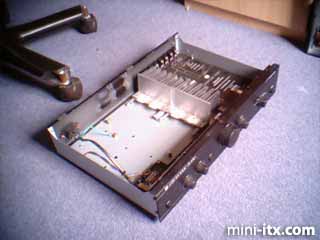
The case with the heatsinks.
 |
 |
 |
Quick Links
Mailing Lists:
Mini-ITX Store
Projects:
Show Random
Accordion-ITX
Aircraft Carrier
Ambulator 1
AMD Case
Ammo Box
Ammo Tux
AmmoLAN
amPC
Animal SNES
Atari 800 ITX
Attache Server
Aunt Hagar's Mini-ITX
Bantam PC
BBC ITX B
Bender PC
Biscuit Tin PC
Blue Plate
BlueBox
BMW PC
Borg Appliance
Briefcase PC
Bubbacomp
C1541 Disk Drive
C64 @ 933MHz
CardboardCube
CAUV 2008
CBM ITX-64
Coelacanth-PC
Cool Cube
Deco Box
Devilcat
DOS Head Unit
Dreamcast PC
E.T.PC
Eden VAX
EdenStation IPX
Encyclomedia
Falcon-ITX
Florian
Frame
FS-RouterSwitch
G4 Cube PC
GasCan PC
Gingerbread
Gramaphone-ITX-HD
GTA-PC
Guitar PC
Guitar Workstation
Gumball PC
Hirschmann
HTPC
HTPC2
Humidor 64
Humidor CL
Humidor II
Humidor M
Humidor PC
Humidor V
I.C.E. Unit
i64XBOX
i-EPIA
iGrill
ITX Helmet
ITX TV
ITX-Laptop
Jeannie
Jukebox ITX
KiSA 444
K'nex ITX
Leela PC
Lego 0933 PC
Legobox
Log Cabin PC
Lunchbox PC
Mac-ITX
Manga Doll
Mantle Radio
Mediabox
Mega-ITX
Micro TV
Mini Falcon
Mini Mesh Box
Mini-Cluster
Mobile-BlackBox
Moo Cow Moo
Mr OMNI
NAS4Free
NESPC
OpenELEC
Osh Kosh
Pet ITX
Pictureframe PC
Playstation 2 PC
Playstation PC
Project NFF
PSU PC
Quiet Cubid
R2D2PC
Racing The Light
RadioSphere
Restomod TV
Robotica 2003
Rundfunker
SaturnPC
S-CUBE
SEGA-ITX
SpaceCase
SpacePanel
Spartan Bluebird
Spider Case
Supra-Server
Teddybear
Telefunken 2003
TERA-ITX
The Clock
ToAsTOr
Tortoise Beetle
Tux Server
Underwood No.5
Waffle Iron PC
Windows XP Box
Wraith SE/30
XBMC-ION