

Posted on April 28, 2003
|
|
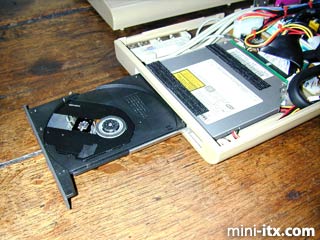
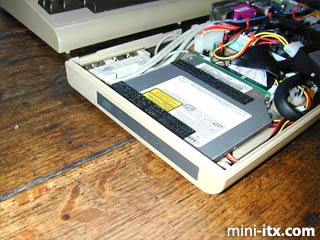
Noticed the two Velcro strips on the DVD-player? They are the attachment points for the harddisk that is mounted on top of it (Maxtor D740X, 40 GB, 7200 RPM). Any concern about the robustness of this construction evaporated after playing with the optimal position of the harddisk. This is a very secure way to fix stuff. Below you see an overview of the, nearly completed system. I put in a round IDE cable because it looks a lot better and provides a cleaner space for (probably) better airflow. Also notice the abundant use of tie wraps on the ATX power cable and USB/Firewire cable for the same purpose.
|

On the right side the original C64 metal lid can be seen. Normally this would house the power connector, power button and the two joystick ports. I converted it by glueing a piece of aluminum on the backside and drilled holes in it to contain two leds and two push button switches. The green led is lit when in "sleep mode", the red led is the "on/off" indicator. The red button is for resetting, the black one for powering up/down the system.
|
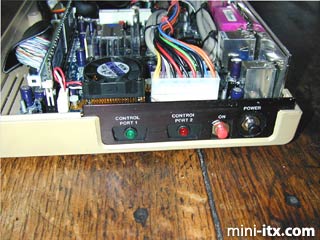
Cables were soldered on the leds and switches and plugged in the board. The original power led on top of the C64 casing was connected to the harddisk led output. That way the disk activity can be easily monitored.
Ok, now with the bulk of the work done, this is what the (almost) completed machine looked like.
|
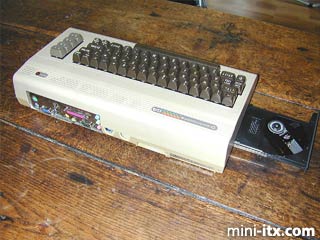
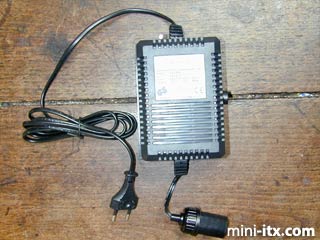
The two round openings on the back were subsequently closed by glueing another aluminum plate on the inside of the case. In one, a hole was drilled to allow for the fitting of the 12v power connector. The power for this C64 comes from a crude PSU originally manufactured to power camping refrigerators. For this humble but noble purpose, it delivers 13 volt and 5 amps, therefore it must also be able to provide the juice needed for the EPIA to play DVDs and do some background tasks. And besides it only cost 19.95 euros. You will be hard pressed to find a OEM PSU for that money. Excellent value I would suggest. Converting the cigarette lighter cable was a piece of cake.
After some preliminary test-runs the plans for incorporating the PSU in the C64 casing were rejected. Although the power consumption is low, things can get warm in there.
Once, I measured over 70 degrees from the CPU on an, admittedly, warm day while playing a DVD without any tasks running in the background. Probably the relatively poor airflow is to blame here. I am considering using the opening next to the power connector at the backside to get some airflow with a 40 mm fan located behind it. Maybe, it will not be necessary; I will have to do some more CPU-demanding tests here.
|
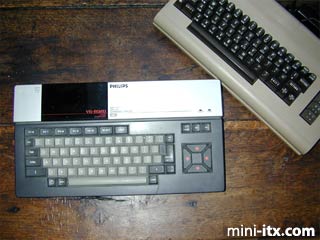
Ok, that is more or less how this Commodore got to run at a frequency 911 times its original speed. Last week I got hold of a box full with original Commodore goodies including a working C64, a PSU, datarecorder, joysticks and disk-drive (all this set me back a full 8 euros on Ebay, damn they get pricier every day), so a few things have been added on the to-do list:
- Getting the keyboard to function. I tried
squeezing the standard PS2 foil in the keyboard but with limited
success and destroying the original wiring. Neil who built
the Commodore ITX-64 might provide
a solution here.
- Fitting an optical mouse in the original joystick. This
should be cheap, easy and fun to do. I"ll just have to
provide some room and make the "fire" switch to
function again :-)
- Hiding the camping PSU in the datarecorder. Fun and easy
as well.
Incorporating an infrared led somewhere on the casing for
communication with phone, PDA etc. The M9000 has fast-IR on
board you know…
- Improving airflow to cool things down, as mentioned in the
text.
Now that this little project is finished, I will have to find myself something new to pass time with. Maybe I should have closer look at that new M10000 board. Nice.
Hmm, tempting, maybe try a smaller HD drive, fit it in a different case. Maybe create a whole bunch of retro looking EPIAs. Let"s see, if we could just find something nice to put it in…
(Oh-oh, the Geek inside and Nostalgia took over again)
|
I"ll let you know when the new toy is up and running.
Ciao,
DocLorren
 |
 |
 |
Quick Links
Mailing Lists:
Mini-ITX Store
Projects:
Show Random
Accordion-ITX
Aircraft Carrier
Ambulator 1
AMD Case
Ammo Box
Ammo Tux
AmmoLAN
amPC
Animal SNES
Atari 800 ITX
Attache Server
Aunt Hagar's Mini-ITX
Bantam PC
BBC ITX B
Bender PC
Biscuit Tin PC
Blue Plate
BlueBox
BMW PC
Borg Appliance
Briefcase PC
Bubbacomp
C1541 Disk Drive
C64 @ 933MHz
CardboardCube
CAUV 2008
CBM ITX-64
Coelacanth-PC
Cool Cube
Deco Box
Devilcat
DOS Head Unit
Dreamcast PC
E.T.PC
Eden VAX
EdenStation IPX
Encyclomedia
Falcon-ITX
Florian
Frame
FS-RouterSwitch
G4 Cube PC
GasCan PC
Gingerbread
Gramaphone-ITX-HD
GTA-PC
Guitar PC
Guitar Workstation
Gumball PC
Hirschmann
HTPC
HTPC2
Humidor 64
Humidor CL
Humidor II
Humidor M
Humidor PC
Humidor V
I.C.E. Unit
i64XBOX
i-EPIA
iGrill
ITX Helmet
ITX TV
ITX-Laptop
Jeannie
Jukebox ITX
KiSA 444
K'nex ITX
Leela PC
Lego 0933 PC
Legobox
Log Cabin PC
Lunchbox PC
Mac-ITX
Manga Doll
Mantle Radio
Mediabox
Mega-ITX
Micro TV
Mini Falcon
Mini Mesh Box
Mini-Cluster
Mobile-BlackBox
Moo Cow Moo
Mr OMNI
NAS4Free
NESPC
OpenELEC
Osh Kosh
Pet ITX
Pictureframe PC
Playstation 2 PC
Playstation PC
Project NFF
PSU PC
Quiet Cubid
R2D2PC
Racing The Light
RadioSphere
Restomod TV
Robotica 2003
Rundfunker
SaturnPC
S-CUBE
SEGA-ITX
SpaceCase
SpacePanel
Spartan Bluebird
Spider Case
Supra-Server
Teddybear
Telefunken 2003
TERA-ITX
The Clock
ToAsTOr
Tortoise Beetle
Tux Server
Underwood No.5
Waffle Iron PC
Windows XP Box
Wraith SE/30
XBMC-ION